Today I’d like to share my response to a question I wrestled with, as have many teachers in elementary and high school classrooms. How do I get my students to move from a three-line description to a whole narrative? What I finally discovered is that if I use student work as a model that I put up on a screen, it makes it possible to teach in a manner which is relevant. It is 100% more effective than any feedback written on individual papers sent to us to mark at home.
Requires a Certain Degree of Confidence
What? I don’t have to mark their papers at home, eating up my nights? Yep. This way of giving feedback is more powerful, but it does mean you are taking a risk. You are working in front of the students. You have to think on your feet. And you have to know your stuff.
How do you get to that point of confidence? You read what writers have to say about writing. Stephen King has an excellent book on writing. You take classes on writing, audit university classes, sign up for online workshops, and join a writing group. You write, write, write.
I have always found it amazing that everyone thinks they can automatically know the tricks of the writer’s trade just because they can read and have managed to get a university degree without really being taught how to improve their writing.
Using Narratives
Because stories are a form of writing we are most familiar with in our lives, and because writing stories about our own experiences makes the work relevant, I highly recommend teaching writing through narrative. It is a sad mistake that almost all student writing is intended to demonstrate knowledge of a subject.
The most interesting subject is the students themselves. Self-identity is more important to success than knowing about the French Revolution. Educators are just beginning to understand that.
I’ve nothing against learning about the French Revolution. History teaches us to better understand the present times and the influences that change how the world works. But let’s not ignore the part about how we work. People get hired and fired more for who they are than for what they know.
I shudder at the thought that AI may be changing how we function as human beings. Will identity be lost or become more significant? It is a thing to ponder, for sure. But not in this article. Today, we focus on things we have control over. Today, I am going to talk about using student work as curriculum.
A Working Example
This is how the scenario might go in an English classroom, or any classroom where developing a strong personal identity is the goal and writing of narratives is the strategy being used.
The teacher might, for example, invite students to compose a story about a relative they care about. “Choose one incident that lets us, the reader, know a little about your grandfather. “I usually ask for a narrative 2-3 pages long. It is an ideal length for sharing. Longer takes too much time. 2-3 pages teaches the student to focus and to stick to the subject. I don’t ask for everything they know about the person. Just one aspect of that person’s personality or life that is interesting to them.
At first, the response is a quick summary of the story, not the story itself.
Grandfather was so strong that he stopped a horse from getting killed. Grandmother always worried Grandfather would have a heart attack someday.
When the teacher receives these three sentences, it is important to be positive and inform the student that this is a good incident, but could they write more vividly, adding description.
This, of course, can be done by the teacher writing this comment on the composition and handing it back.
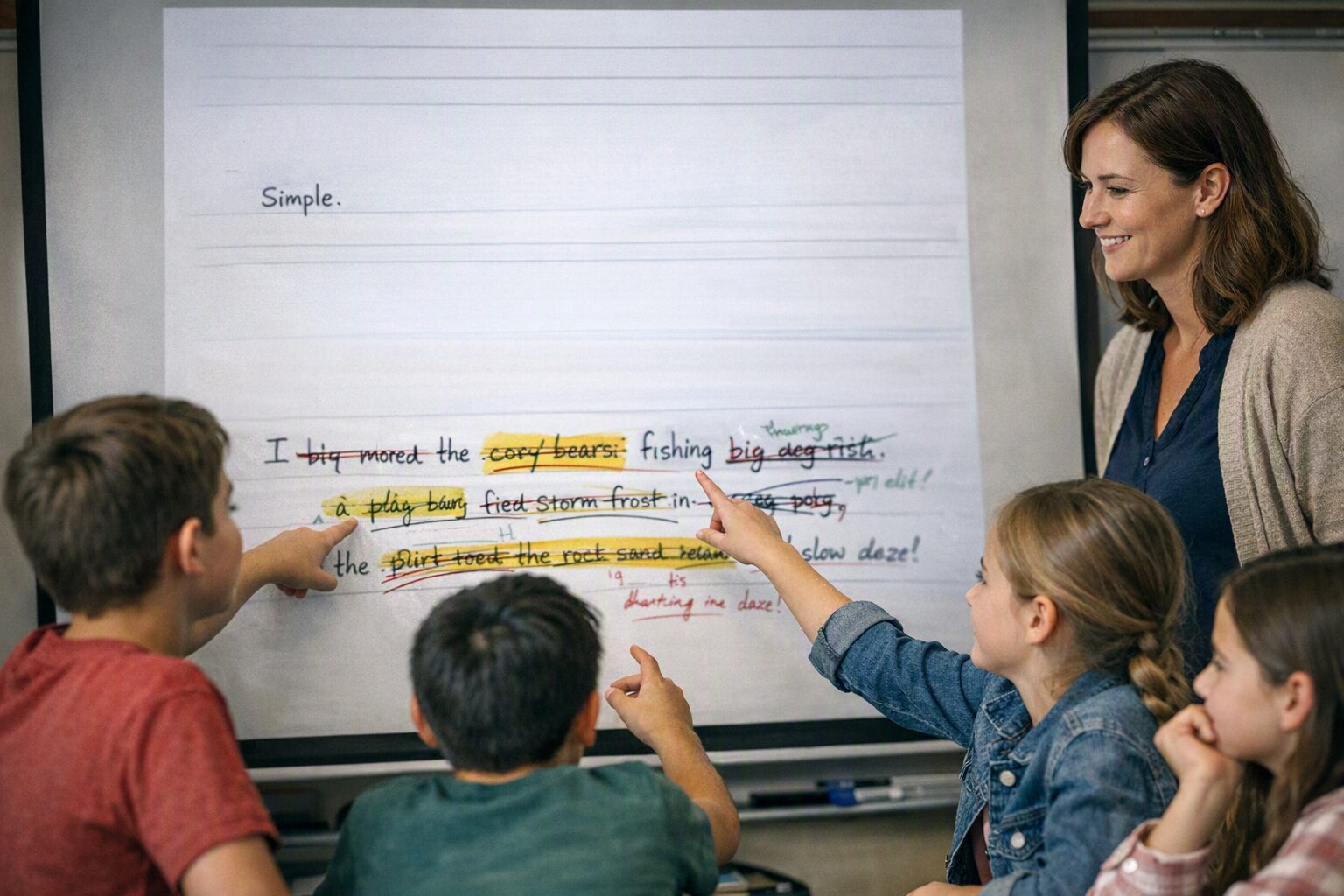
However, if you project the sentence onto a screen, you teach everyone, not just the writer of this piece. You are honouring the work. The idea is a good one, and you are willing to put your energy and time, and the students’ energy and time, into making it even better.
It is not a correction. It is not really an evaluation. It is not a time to grade. It is a time to LEARN.
Several different students might offer ways to make the student be more specific. Often this is done by asking questions of the writer. The writer naturally gives more information.
You give the student time to come up with a descriptive sentence, showing more detail. If all the students have computers, the student can project their sentence. Or the teacher can write it as the student dictates.
It may go something like this:
My 83 old grandfather once stopped my beautiful black pony from getting killed. Grandmother always worried Grandfather might drop dead of a heart attack during his strong man adventures.
What I have just described is an all-too-common disappointment. Students often think an idea is the same as a narrative. An idea is just that, an idea. The teacher’s assignment was a good one. The topic was universal so that the whole class could write on one topic and each student could write a personal, unique narrative. Why did it not get the results they wanted?
Students don’t know how to do what the teacher has asked them to do.
We can ask someone to do something, specific, 3 pages long until the cows come home and they can’t do it until the teacher shows them how. They’ve got the what-to-do; now comes the hard part.
So, we all have to forget the notion that good instructions on what and how long the narrative has to be are enough. That doesn’t work unless they have been taught how to do that. Some students might just naturally do what the teacher wants. Most often, those students have been avid readers of literature. Also, the students will likely come from homes where reading and writing are done regularly. They see their parents and siblings use reading and writing as a natural part of living.
Not all students are that lucky.
Start with What They Have Done Well
When a teacher asks for a more descriptive composition, most students do what the sample student did: add a bunch of adjectives. Descriptive usually translates into big, heavy, bold, angry, loud, brave, strong, etc.
It is important to recognize that an honest attempt has been made. “That’s a good start.” If the descriptive adjective they add suggests a characteristic, go from there. ALWAYS ATTEMPT TO USE WHAT THE STUDENT HAS WRITTEN TO MAKE THEM FEEL GOOD ABOUT THEMSELVES. Students do best when they feel they are capable of doing what you ask of them.
This student thought of a good idea. They also came up with a descriptor that would identify the character. A strong grandfather who shows how strong he is by saving your horse. The student has also brought in a secondary character and an emotion or feeling about the grandfather’s personal life; the wife of the grandfather is worried that he is too old to be involved in antics revealing strength.
Congratulate the student. Say WHAT they have done that is working. You are using STUDENT’S WORK AS A SOURCE OF YOUR CURRICULUM. You are not just giving a rule. There is dialogue, there is rewriting. That’s the true process of revision. All writers revise. We all start with an idea and turn it into something we can visualize as we go. It takes time. It takes skill. To get that skill, it is essential to work on the piece itself.
It is so much more meaningful than a lesson written by some expert in a book. Personally relevant topics will motivate them to do their best work.
I began the habit of putting such work up on a screen. It gave me the opportunity to work with the whole class, showing them how this great start could become an excellent narrative that would engage readers.
By doing this, you are honouring the student’s work. Trust me, though the students may be a bit leery at first, they will come to enjoy your working on something they’ve done; they will want you to do it more and more.
Let them know that the writer’s idea is very good and can become even better. First of all, the student has followed the instructions on the topic… some relatives they know well, one incident and some description. Great. When you are sharing the work, it is much easier to discuss it this way. It would take pages of feedback to get all the ideas to the student.
Dialogue. Conversation. That’s the way that has made the most sense to me.
At first, I did this one-on-one with the student coming up to my desk, and together we’d go over the composition and rework. But I rarely had time to work through all the work in the way it deserved. That’s why I began sharing with the class and inviting them into the revision process.
This is Teaching
Once you have enough material to work with, you are ready to say what is working and what could work better. You can teach the writer’s “tricks of the trade”. You never say how they have done it is wrong. You always work from the positive, and together with the student and the whole class, you will develop a piece worthy of the time and energy everyone puts into the work.
Published writers have “tricks of the trade” just as people who build cars, bake cakes, or perform surgery do. It’s the “know-how” of the job. Today, the job is to turn an idea into a story.
By using the language of “what a writer does”, “published work”, tricks of trade of a writer”, you are establishing a feeling of students being capable of writing.
There is a lot of debate among educators about whether writing can be taught. I can promise my students they will learn to improve their writing to the point that they can find magazines that will publish their work. I cannot promise to turn them into Stephen King or J. K. Rowling.
As Robert Frost once wrote, “a writer first of all must be able to see what is worth writing, recognize something in life that will make a fabulous story or poem or essay and then have the skill to turn it into something so others can see the truth and beauty in it. I feel confident they will learn a bit of each of those essential attributes.
Could you teach students to become famous writers or writers who make a living by writing? Margaret Atwood, a famous Canadian writer, once admitted that if she had been paid for her writing, her salary would have been about 5 cents a story. She had to write and write and write. Until her book got turned into a television series, she was not a rich woman. It took her a lifetime and the luck of a network to feel that the audience was ready to receive her work and pay the network to watch it.
I must acknowledge that I am in the camp of those who think such writers are born, just as some doctors can cut out an appendix successfully while others are healers. They have the skill, but something else too, and no one really knows how to describe it or teach it. But we can certainly recognize it when we are lucky enough to be in the hands of such a gifted human being.
The first thing I want to show my students about the writing that I am projecting and that we are working on to revise the work, I am teaching the class the HOW OF WRITING. I really want them to know that modifiers (descriptors, adjectives, adverbs) are not the way to make their writing come alive.
Verbs are the things that work. So, you want to say the grandfather is strong? His strength is the characteristic that stands out in your memory? Saying he is strong does not convince us. Instead, we need to show that what he is doing requires strength. The old adage most of us recognize is “show, don’t tell”. I’ve discovered that students believe they are showing when they add descriptors. Instead, I recommend giving the characters actions that demonstrate that strength.
I may turn to the class and ask them to talk about things they have seen or done that demonstrate strength. Specific things. I sometimes write them on the board. Or we just share our memories. Then I turn to the projected story and read the line that shows the grandfather stopping a horse from killing itself.
I ask students to describe what they picture in their heads when they read those words. Of course, a whole bunch of different pictures come up. Then I turn to the student who wrote the composition and ask if anyone got it exactly right. Most often, not one person has read the student’s mind totally as it happened and as they remember it.
In answering my question about the readers getting it right, the student will usually naturally describe the actual event he was thinking about. Bingo! He knows. He can write the event now.
Easier on the Teacher Once They Have the Tools
Using the work to invite discovery, letting the student have the power, is so much more effective than giving a lecture, assigning a writing task, and marking and returning it. I promise you, it works wonders. And it’s a lot of fun for everyone. And you don’t have to lug 25 papers home and mark into the midnight hours.
I might, at that point, remind the students of the writing process I have discussed. What we are exploring together is the third important component of the writing process that all writers must do. We are searching for specifics.
I jot down all the specifics the writer can imagine. The 3 lines turn into a narrative and become. . .
Grandfather threw himself at the horse, wrapping his arms around the animal’s neck. (start with action)
The horse screamed, grandfather grunted and both dug their heels into the hard dirt until
Dad rushed into the arena, cut the lead rope and released the pony. (use details action words what they DID)
The students are getting closer and closer to a story. There is still a lot of work to do, but the writer is now applying “writer’s tricks of the trade” ( action instead of description to make the story come alive).
That would be about as far as I would go for one day. Once I was certain students understood this concept, I could teach another trick of the trade. It is tempting to continue teaching, but it is essential that the students have time to internalize one concept at a time. Once they are comfortable using this concept, it will become natural to them, and you can go on to another.
How? By finding a teaching moment in the student’s writing.
For example, in this short study, they have already naturally fallen upon what I might teach next… talk about using the senses to make the narrative come alive. They have suggested paying attention to sound. The horse screamed. Grandfather grunted. (That would be a good lead-in.)
I might decide to let students work on this composition, leaving it up on a whiteboard or a flip chart until it becomes a complete narrative, always having students come up with suggestions. I want to keep instilling the notion that they know so much about the subject already. I just need to give them the opportunity to let it show itself.
Using a single composition as a teaching aid would be a mistake. It is important to tell different stories at all times so that every student has a chance to shine. There is a temptation to use the best writing because it offers more opportunities to teach “what works” – showcase a trick of the trade you want to teach.
Giving Students a Sense of Power
However, that is a mistake, too. It is our job as teachers to find something that works for every child’s composition. Sometimes we have to search hard, but there is always some gem in the work. There is always a way to include every student in the class and to give them a sense of power.
Power? What am I talking about? Yes, power. One of the basic needs all creatures have is control over their own lives. When a student sees their paper projected on the screen as a good example of how to do something, it makes them feel powerful.
The sense of control comes a bit later, gradually. As the student gets control of their work, knows how to entertain, amuse, inform, affect emotions, they feel powerful. The readers can visualize the story, see it unfold, hear the sounds, recognize the smells; in other words, the story comes alive. Because they need to feel some sense of power, the feeling they get from writing a story or poem or essay that can affect others becomes a motivating element of teaching writing.
It has been my happy experience that once students progress to that level of being able to affect others with something they have experienced and written about, I never had to worry about motivating students again. On the contrary, they wrote so many stories that I became overwhelmed and had them form writing groups. There wasn’t enough class time to work on all of the compositions that were pouring in.
What a terrible dilemma to have!
Key Takeaways
- The problem is rarely a lack of ideas — it is that students have not been taught how to turn an idea into a narrative. Teaching the craft matters more than assigning the task.
- Action is stronger than adjectives. Show strength, fear, and emotion through what characters do, not through the words used to describe them.
- Always begin with what the student did well. Confidence is the foundation of good writing, and every piece of student work contains something worth building on.
- Teach one skill at a time. When students focus on a single technique — action, sensory detail, dialogue — the learning sticks. Trying to teach everything at once teaches nothing.
Frequently asked questions
What does it mean to use student work as curriculum?
The teacher projects a student’s writing on a screen and works on it with the class. The article says this is more powerful than written feedback on papers marked at home, though it takes confidence because you are working in front of students.
Why teach writing through narrative?
Stories are the form of writing we know best, and writing about our own experiences makes the work relevant. The article argues that the most interesting subject is the students themselves.
Why do students hand in two or three sentences instead of a narrative?
Many students do not know how to turn an idea into a narrative and confuse description with storytelling, so they add adjectives instead of expanding the story.
How can teachers respond to a very short piece of writing?
Begin with what the student did well, project the writing and work on it together as a class, and teach one writing skill at a time, such as action instead of description.
How do you teach “show, don’t tell”?
Explain that action is stronger than adjectives. Instead of writing that a character was strong, ask students what actions demonstrate strength and let those details become the scene.